
AI Trading
Why Automated Trading Beats Manual Trading for Most People
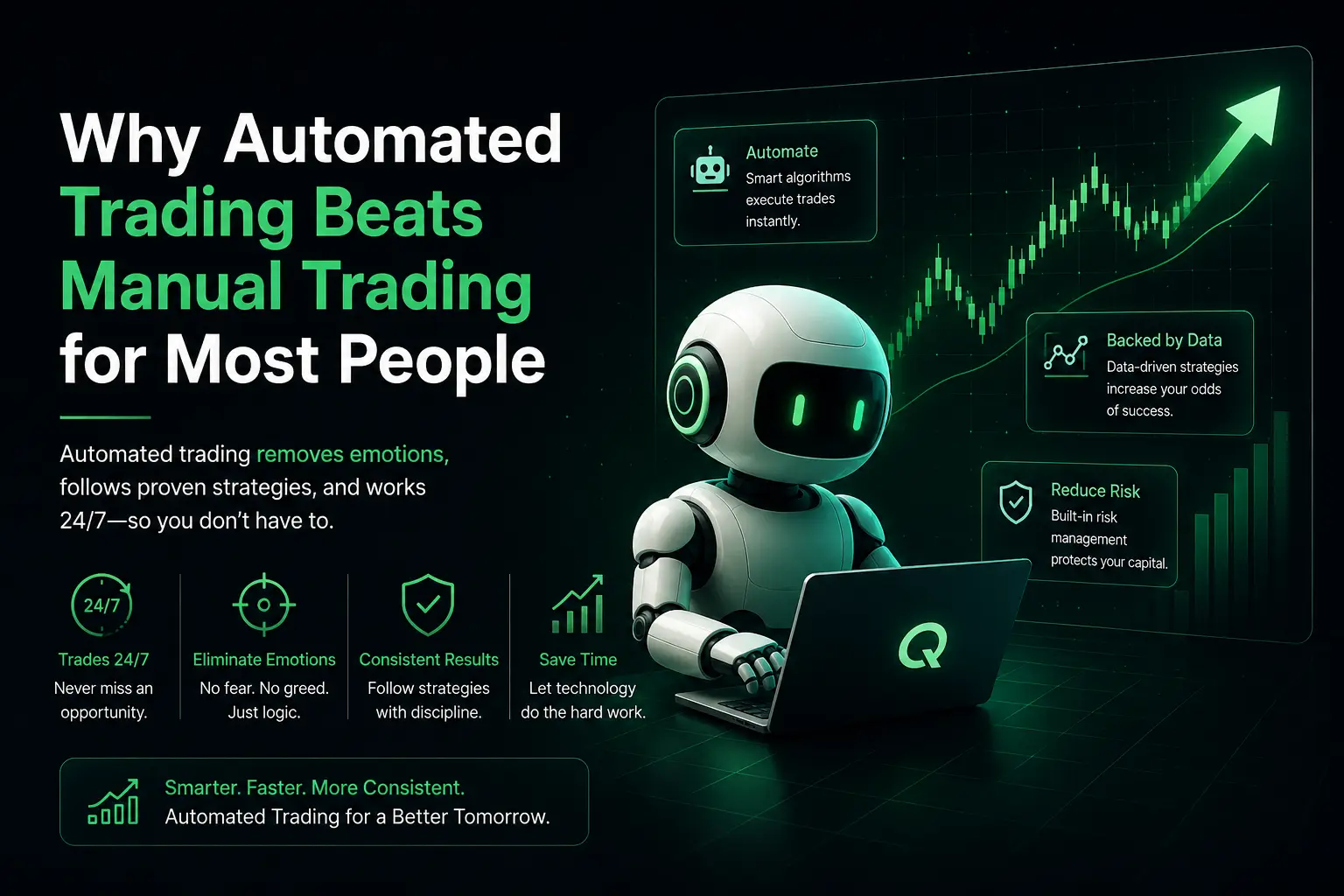
The market does not care about your sleep schedule, your job, or your mood. Automation removes those frictions — and the data on retail manual trader performance is brutal. Multiple regulator-published studies across the last decade show that the majority of self-directed retail traders lose money over any reasonable observation window. That is not because they are stupid; it is because the structure of the activity is rigged against them.
This guide makes the honest case for why automation wins for the average investor, walks through the three biggest leaks of manual trading, and acknowledges the narrow situations where manual still has the edge.
The structural problem with manual trading
Discretionary trading is essentially a continuous decision-making job competing against full-time professionals with better tools, better data, and 24/7 desks. The retail trader brings a phone, a charting app, and a few hours of attention per day. The asymmetry is total. Add in commission costs, spread costs, and the psychological weight of every open position, and the math gets ugly fast.
Three leaks of manual trading
Leak 1 — Emotional revenge trades after losses
After a losing trade, the brain releases stress hormones that bias the next decision toward 'making it back' rather than 'taking the next high-EV setup'. Every experienced trader has felt this and most have lost weeks of progress to a single revenge sequence. Automation does not feel revenge.
Leak 2 — Missed setups while sleeping or working
Markets run when you are at work, asleep, or on holiday. Manual traders miss most of the opportunity set by definition. An automated system covers all sessions across all time zones simultaneously. This is a bigger edge than most people realise.
Leak 3 — Inconsistent risk sizing
Discretionary traders famously size based on conviction — bigger bets on 'this one feels right'. Statistically, conviction is uncorrelated with outcomes. Automation sizes based on the rules every time, which means the long-run distribution of outcomes is determined by the strategy and not by mood.
What automation fixes
Qorix executes the same disciplined process across thousands of opportunities every month — without ego, fatigue, or fear. Every fill is logged. Every risk cap is enforced. Every exit is planned before the entry. The compounding effect of consistency over months and years dwarfs any individual trade decision a discretionary trader could make.
What the studies actually show
- European regulator data has consistently shown 70-85% of retail CFD/forex traders lose money over a quarter
- Studies on retail crypto traders show similar or worse outcomes during full cycles
- Studies on professional algorithmic strategies routinely show positive expected value over long horizons
- The gap is structural, not motivational — discipline at human reaction time is the bottleneck
When manual trading still makes sense
There are narrow cases where manual wins. They are real, and we will not pretend otherwise.
- Trading as entertainment with money you have explicitly classified as fun money
- Specialised event-driven plays where you have unique private information (and remember insider trading is illegal in regulated markets)
- Building skills as a future professional trader where the learning is the goal, not the P/L
For everyone else — investors trying to grow capital efficiently — automation is structurally the better choice.
But isn't automation 'cold'?
Yes, in exactly the way you want a surgeon to be cold during an operation. Cold is good when you are managing money you cannot afford to lose to your own moods. Warmth is appropriate for hobbies — money is not a hobby.
The market is the most expensive place in the world to discover your emotional weaknesses. Automation pays the price for you.
What you give up by automating
You give up the dopamine of clicking buttons, the bragging rights of an individual winning trade, and the illusion that you are 'doing something'. For most investors trying to compound capital, this is the best deal in finance — and surprisingly hard to accept until you have lived through it.
How to switch in two days
- Day 1 — Open a Qorix account, deposit a small amount, pick a risk tier
- Day 1 evening — Stop placing manual trades on whatever platform you currently use
- Day 2 — Watch your dashboard once. Then close the tab
- Day 30 — Compare your last 30 days of automated performance to your previous 30 days of manual
Read more about how the underlying engine works in our companion guide on how AI trading actually works in 2026.
Switch to automatedContinue reading