
Education
Risk Management Fundamentals Every Investor Must Know
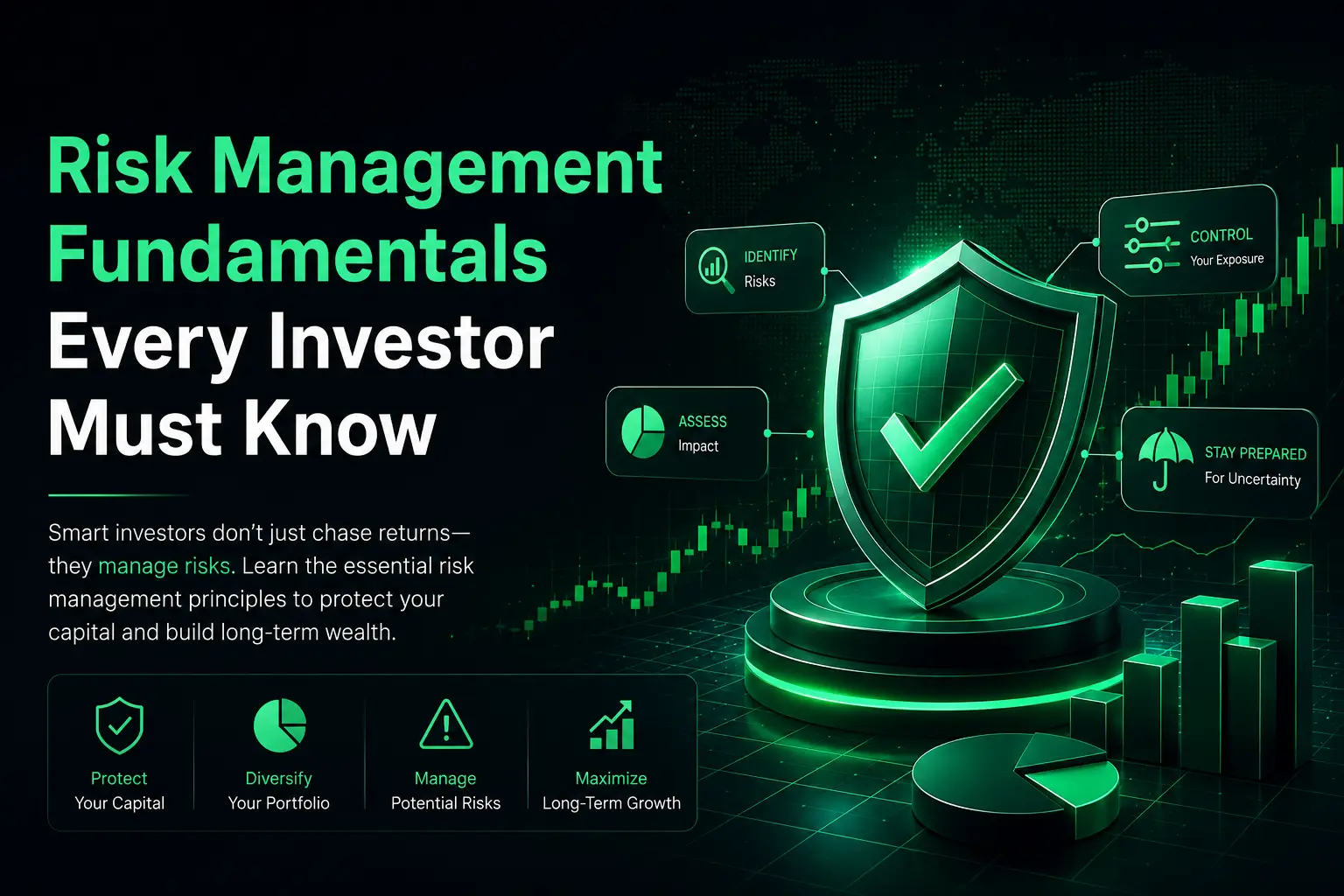
Profits are loud. Risk is quiet — until it is not. The investors who compound for decades obsess over the second number. Every legendary track record in finance has the same boring story underneath: small losses, smaller losses, occasionally a great year, never a catastrophic one. The rules below are how that gets done in practice.
Whether you trade manually or run a managed portfolio on Qorix, internalising these five rules will change how you think about every decision. We will explain each one in plain English, give a worked example, and show how the Qorix engine enforces it automatically.
Rule 1 — Cap your maximum drawdown
Drawdown is the peak-to-trough decline in your portfolio value. A 50% drawdown requires a 100% gain to recover — that math is brutal and it is the reason professionals fixate on the number. The single most important risk control you can have is a hard ceiling on how much you allow the portfolio to fall before you pause.
How Qorix enforces it
Every risk tier has a built-in drawdown limit. If the strategy hits that limit, trading auto-pauses and a sticky banner appears on your dashboard. You can resume manually when you are ready, or wait for the engine's reset window. This is not a vibe — it is hardcoded into the execution layer.
Rule 2 — Size positions, not opinions
Beginners size their positions based on conviction. Professionals size based on stop distance and account risk. The classic formula is: position size equals account risk per trade divided by stop distance in dollars. Get this right and even a string of losses barely scratches the portfolio. Get it wrong and one bad day ends the run.
A worked example
If you are willing to risk 0.5% of a $1,000 account on one trade, that is $5. If your stop is at -50 cents per unit, you can hold 10 units. The Qorix engine runs this calculation per fill, per asset, factoring in the correlation between open positions so you cannot accidentally stack the same bet across symbols.
Rule 3 — Diversify across uncorrelated markets
Holding ten positions that all rise and fall together is not diversification — it is leverage on the same idea. True diversification means owning assets whose returns are weakly or negatively correlated, so a bad day in one is partially offset by a flat or up day in another.
What this looks like at Qorix
- Forex majors — driven by macro and rate expectations
- Gold — driven by inflation and crisis hedging
- Indices — driven by broad equity sentiment
- Crypto majors — driven by digital-asset specific flows
These four buckets do not always agree — and that disagreement is exactly what smooths the equity curve. Read our portfolio diversification playbook for the full per-tier allocations.
Rule 4 — Take profits systematically
Wins that are not realised are not wins yet. Discretionary traders famously give back profits because they never decided in advance what 'enough' looked like. Systematic profit-taking — whether through trailing stops, scheduled rebalances, or scaling out at predefined levels — converts paper gains into something the portfolio actually keeps.
On Qorix, every position has a planned exit at the moment it opens. The auto-compound feature additionally takes a portion of realised profit and recycles it back into the working capital each cycle, so winners keep working for you.
Rule 5 — Plan the exit before the entry
The single biggest psychological trap in trading is deciding what to do about a position after it has moved. By then, your decision is contaminated by the position's P/L. The professional answer is to commit to an exit plan — both a stop-loss and a take-profit — at the moment you enter.
The Qorix engine does this for you on every order. There is never a position open without a stop attached. You will never log in to find a 'forgotten' losing position that quietly bled out.
Plan your exit before your entry. The only good trade is one that already had its rules written down.
Bonus rule — protect against ruin, not against discomfort
Most investors confuse drawdown with risk. They are not the same. A 5% drawdown that you can survive is uncomfortable but informative. A 50% drawdown that you cannot survive is ruin. Risk management is about avoiding the second category, not about avoiding the first. If you cannot tolerate any drawdown at all, your only honest option is a savings account — and even that has inflation risk.
How to internalise this in 30 days
- Day 1 — Pick your risk tier and write down the drawdown limit on a sticky note
- Days 2-15 — Check the dashboard once a day, no more. Note your reaction to each move
- Day 16 — Review the worst day and ask if you would have done worse manually
- Day 30 — Decide whether to add capital, hold steady, or step down a tier
Want a deeper dive on the math of compounding?
Risk management is the floor; compounding is the ceiling. Read our compounding monthly returns guide to see what disciplined risk plus monthly reinvestment turns into over years.
Open a risk-managed portfolioContinue reading
Related articles
Related tools
Related resources
Continue in the Trading Places academy guide.