Pricing
Zero Fee Trading — How Qorix Makes Money Without Charging You
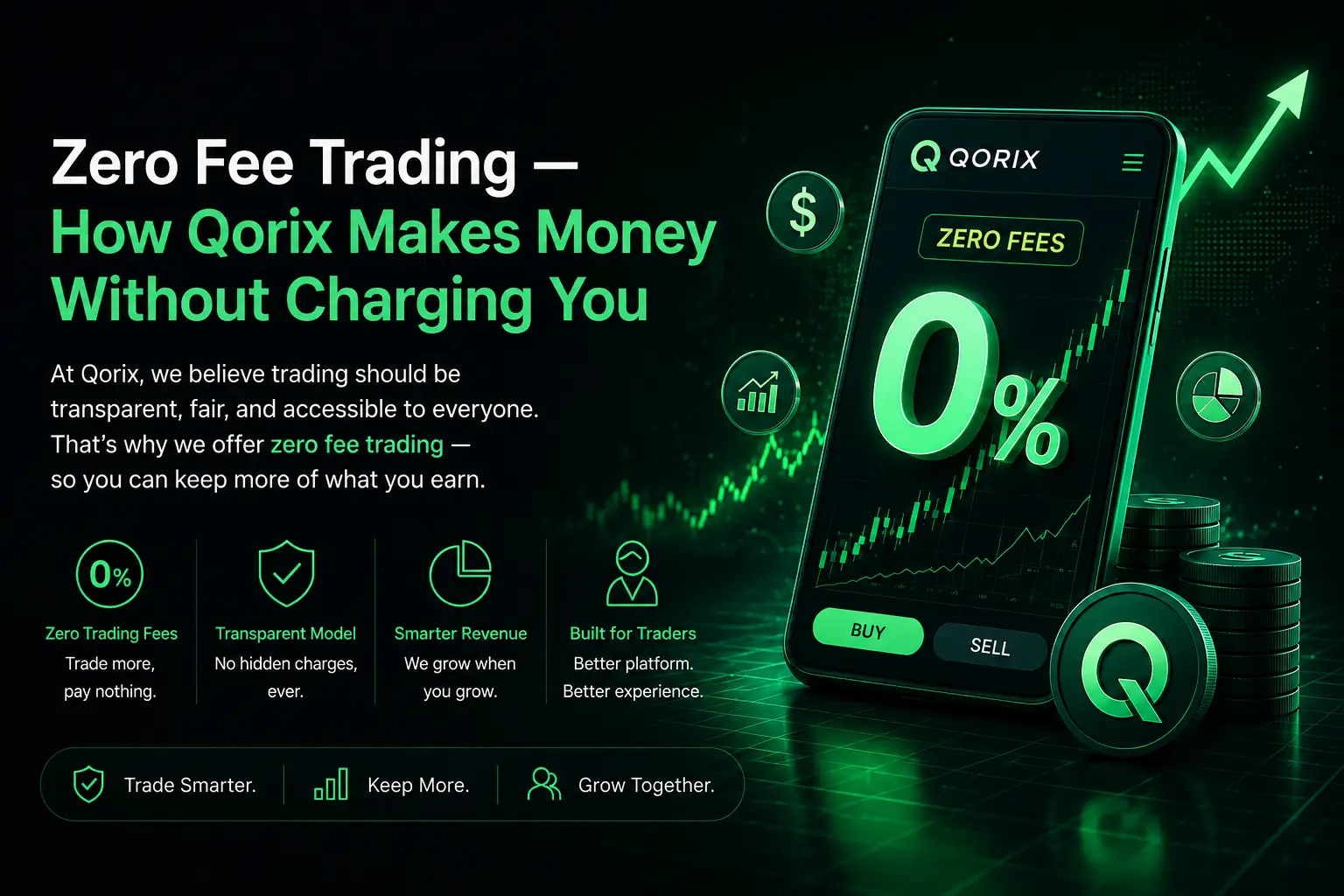
Most brokers nickel-and-dime users with spreads, commissions, swaps, and inactivity charges. By the time a self-directed trader notices, a meaningful chunk of their year's return has been eaten by fees they never explicitly agreed to. We took a different path — and the design is deliberate, not a marketing slogan.
This guide walks through exactly what 'zero fee' means at Qorix, where the platform actually earns its revenue, and why this model aligns our incentives with yours instead of against you.
What zero fee actually means at Qorix
- No deposit fees on USDT — what arrives at the wallet is what funds your portfolio
- No commission per trade — every fill is at venue mid plus the institutional spread, no broker mark-up
- No monthly account fees — your dashboard does not cost you anything to keep open
- No inactivity penalties — you can pause auto-trading and resume without being charged
- No withdrawal fees on USDT (TRC20) up to standard daily limits
These are the headline numbers. The honest follow-up is that there are still costs in the world — venues charge maker/taker fees, blockchains charge gas, and liquidity providers want to be compensated. The difference is that Qorix absorbs those costs into the platform model rather than passing them to you per click.
How the platform actually earns
Qorix shares in profits only when your portfolio earns. Our managed desks operate on a performance model — you keep the bulk of returns and the platform earns a small share on profitable months. If a month is flat or down, the performance share is zero. This is the single biggest structural difference between Qorix and a traditional commission broker.
Why this is good for you
When the platform only earns when you earn, the platform optimises for your long-run survival. Commission brokers optimise for trade volume — the more you trade, the more they earn, regardless of whether you make money. That mismatch is why so many new traders blow up: every nudge in the product is designed to keep them clicking.
Where the operating costs go
Running an AI trading platform costs real money. The biggest line items are venue fees on the order flow, cloud compute for running models 24/7, security and audit infrastructure, custody and treasury operations, and the engineering team that keeps the whole thing reliable. The performance share funds all of it.
The cleanest test of whether a platform is aligned with you is to ask: do they make money when you sit in cash? At Qorix the answer is no.
What competitors charge — for comparison
- Traditional FX broker — 1-3 pip mark-up per trade plus overnight swap, plus often a $5-25 monthly inactivity fee
- Major crypto exchange — 0.10-0.40% per side maker/taker, plus on-chain withdrawal fees that vary with network congestion
- Robo-advisor — 0.25-1.0% annual management fee on assets, regardless of performance
- Hedge fund — traditionally 2% management plus 20% performance
Qorix sits closer to the hedge fund model on the performance side, with no management fee at all. For a small starting balance, this is structurally the cheapest professional execution available.
What about the spread?
Spreads on majors are institutional-grade because the orders route to top-tier liquidity providers and major venues. The engine also actively places maker orders when conditions allow, which captures part of the spread instead of paying it. You see the realised price on every fill in your trade history.
What about hidden costs in the AI itself?
Some platforms quietly tilt their AI toward higher trade frequency to harvest internal margin. The Qorix engine is the opposite — every signal must pass an EV-after-costs check before it fires. If the trade does not clear that bar, the engine sits in cash. That is why some weeks have hundreds of fills and other weeks have very few.
Curious how the math works long-term?
Without commissions and management fees eating your stack, monthly compounding has more to work with. Read our deep dive on the math of compounding monthly returns to see exactly what 4%, 6%, and 8% per month turn into over multi-year horizons.
Try zero-fee tradingContinue reading