Markets
Forex vs Crypto in 2026 — Which Is Better for Beginners? The Honest Comparison
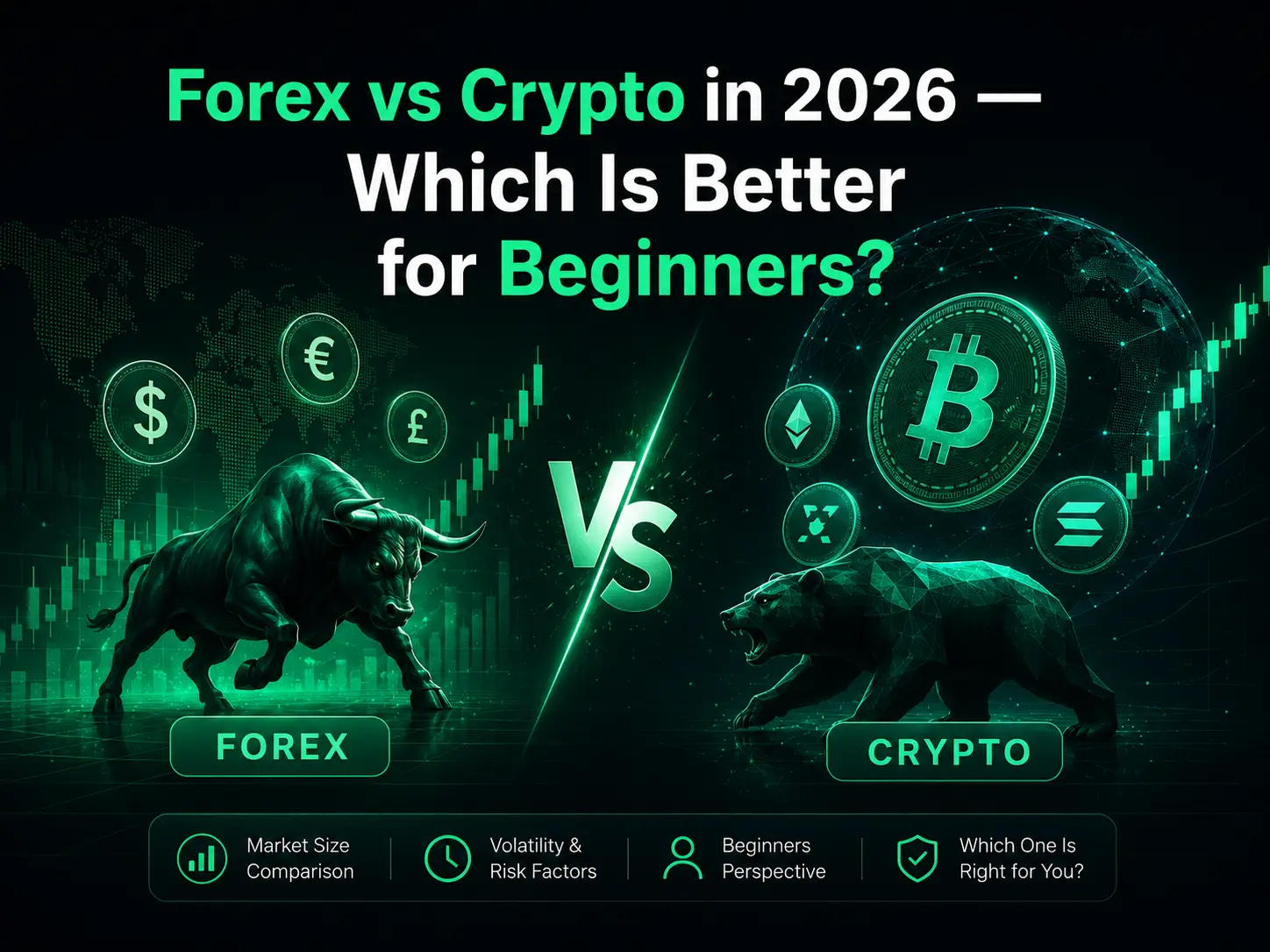
New investors often ask whether to start with forex or crypto. The honest answer depends on your goals, risk appetite, and time horizon — but most online comparisons skip the parts that actually matter and lean on whichever asset the writer happens to trade. This guide gives you the unvarnished side-by-side.
By the end you will know: which market suits a small starting balance, which one rewards patience, which one punishes leverage hardest, and how the Qorix AI desks decide how much of your capital sits in each at any given moment.
The 30-second summary
- Forex — bigger market, tighter spreads, lower volatility, weekday-only, less regulatory drama
- Crypto — smaller market, wider spreads in tail pairs, much higher volatility, 24/7 trading, ongoing regulatory evolution
- Beginners with low risk tolerance — start in forex-heavy allocation
- Beginners with longer horizons and steel nerves — accept more crypto exposure
- Most balanced answer — own both, in proportions that match your tier
Liquidity and trading hours
Forex is the largest market on the planet — over $7.5 trillion traded daily according to the latest BIS triennial survey, Monday through Friday. The market opens with the Sydney session on Sunday evening UTC and runs continuously through Tokyo, London, and New York before closing on Friday evening UTC.
Crypto trades 24/7 with no closing bell. That sounds like a feature, but it can be a bug — the most violent price moves in crypto routinely happen on weekends when traditional desks are closed and liquidity is thinnest. Major pairs like BTC/USDT and ETH/USDT have deep books, but anything outside the top 20 by market cap can have spreads wide enough to make active trading expensive.
Why this matters for an automated system
An AI engine running 24/7 has more opportunities in crypto and tighter execution in forex. The Qorix desks size positions based on the venue's effective liquidity, not the headline market cap. That is why our crypto allocation focuses heavily on majors — the tail looks tempting on a chart but is hard to exit cleanly when conditions change.
Volatility profile
Major forex pairs typically move 0.3% to 1% per day. Major crypto can move 5% in an hour. Higher volatility means more upside and more risk — there is no free lunch. The right way to think about volatility is as a budget: you have a certain amount you can stomach drawing down, and that budget determines how much volatility-rich exposure you can carry.
Quantifying it
On a 30-day annualised basis, EUR/USD typically prints volatility around 7-9%. BTC/USD typically prints around 50-70%. That is roughly an 8x difference. To get the same dollar P/L swing from a $10,000 position in EUR/USD as a $1,250 position in BTC/USD, you would need to size the forex position much larger. Sizing is everything.
Fees and spreads
Forex on Qorix routes through institutional liquidity providers with raw spreads of fractions of a pip on majors. Crypto routes through major centralised venues with maker rebates where possible. Neither carries a per-trade commission for users — see our zero-fee guide for the full breakdown.
Where the costs sneak in for self-directed traders is overnight financing on leveraged forex positions and on-chain network fees on crypto withdrawals. The AI desks are aware of both and factor them into the EV calculation before any trade fires.
Regulation and counterparty risk
Forex is the most regulated asset class on earth at the institutional layer. Crypto is in active regulatory evolution worldwide, with major jurisdictions formalising rules between 2023 and 2026. From a Qorix user perspective, both asset classes are accessed through vetted institutional venues with segregated custody. From a market structure perspective, forex carries less event-driven counterparty drama in 2026; crypto still occasionally produces venue-level surprises that the engine has to route around.
Which one should a beginner pick?
If you cannot tell yet, the honest answer is 'both, in proportion'. Putting 100% of a small starting balance into the highest-volatility asset is how new investors get shaken out in their first bad week. Putting 100% into the lowest-volatility asset means you give up a lot of the upside that justified taking on this kind of investment in the first place.
What 'in proportion' means on Qorix
- Conservative tier — heavier forex and gold, light crypto
- Balanced tier — meaningful slice in each bucket
- Aggressive tier — heavier crypto and indices, lighter forex
How Qorix blends both
Our AI desks allocate across forex majors, gold, indices, and crypto majors based on the risk tier you choose. The allocations rebalance daily as the relative attractiveness of each market shifts — a quiet week in forex during a heavy macro print might shift weight into gold; a crypto vol crush might increase weight in BTC mean-reversion strategies. Read our portfolio diversification playbook for the full breakdown.
The wrong question is 'forex or crypto?' The right question is 'how much of each, given my goal and my time horizon?'
Common mistakes when picking between the two
- Choosing the asset that had the best return last quarter (recency bias)
- Choosing the asset your friends trade (social proof bias)
- Choosing crypto because it 'feels easier' to understand than forex (it is not)
- Going 100% in either before living through one full drawdown cycle
What to do this week
Open a Qorix account, deposit a small amount you can mentally afford to lose, pick the tier that matches your sleep tolerance, and run it for at least 60 days untouched. The market will give you all the information you need to know whether to scale up. Do not optimise before you have data.
Open a managed portfolioContinue reading